Updated: 2026-06-09 · Author: Michael Torres
Why this decision can make or break your casino business
The iGaming Industry rewards operators who pick a platform model that matches their capital and operational readiness, and punishes the ones who don’t. Pick a White Label Casino Solution with a thin balance sheet and no team, and the rev-share keeps stripping margin every month you scale. Pick a Turnkey Casino Solution without the compliance bench to apply for an independent license, and a six-month delay eats the runway you raised on. The two axes that decide this are Initial Investment and Operator Control. Get them aligned with where you actually are in the operator lifecycle, or you end up funding someone else’s growth.
📌 Key Takeaways
- White label = sub-license under the provider’s master license, lower upfront, 15-40% revenue share, 4-8 week launch
- Turnkey = independent license, $50K-$200K+ platform plus license costs, 3-6+ months to launch, full data and brand ownership
- Break-even crossover sits near €200K annual GGR. Below it white label wins on cash; above it turnkey retains substantially more profit
- Curaçao’s LOK reform (2026) eliminated the sub-license model; MGA already restricts B2C white labels
- Practical playbook: start white label only with pre-defined GGR transition triggers written into the contract
Defining the two models: clearing up the industry confusion
Even reputable B2B publications still use “white label” and “turnkey” interchangeably, which is not just sloppy editing. It changes which legal entity holds the gambling license. This section pins down operationally meaningful definitions and exposes the three differentiators that vendor marketing tends to flatten.
What is a white label casino solution?
A White Label Casino Solution is a pre-built Online Casino Platform Provider stack that an operator brands and runs under the provider’s master gambling license through a sub-license. The operator pays a setup fee, monthly platform fees, and an ongoing share of GGR. The provider keeps the backend, the licensing umbrella, the payment integrations, and often the support desk. Think franchising: you get the systems, the brand training, the locked-in suppliers, and you run the storefront. Player Data routes through the provider’s tooling, which is rarely flagged at signing but becomes load-bearing later.
What is a turnkey casino solution?
A Turnkey Casino Solution is a fully configured, deployment-ready platform delivered to an operator who holds their own gambling license and runs the business independently. The provider builds and integrates; the operator owns. That ownership is the structural differentiator. If white label is the furnished rental apartment, turnkey is the house you bought and fitted out. Both give you somewhere to live next week, but only one is on your balance sheet. Operator Control is high, Customization is full, and the license sits in your company name.
Where the industry gets it wrong: the key differences that actually matter
Many providers brand a white label product as “turnkey” because the word polls better with operators who want sovereignty. Strip the marketing and three real differentiators remain:
- License ownership. Turnkey operator holds an independent Gambling License; white label runs under the provider’s master license via sub-license.
- Revenue and fee structure. White label rides on a Revenue Share Model (15-40% of GGR); turnkey leans on higher setup and a fixed or much lower variable fee.
- Platform independence. Turnkey lets the operator switch tooling, swap aggregators, and migrate stacks without provider approval; white label does not.
Cost comparison: what operators actually pay under each model
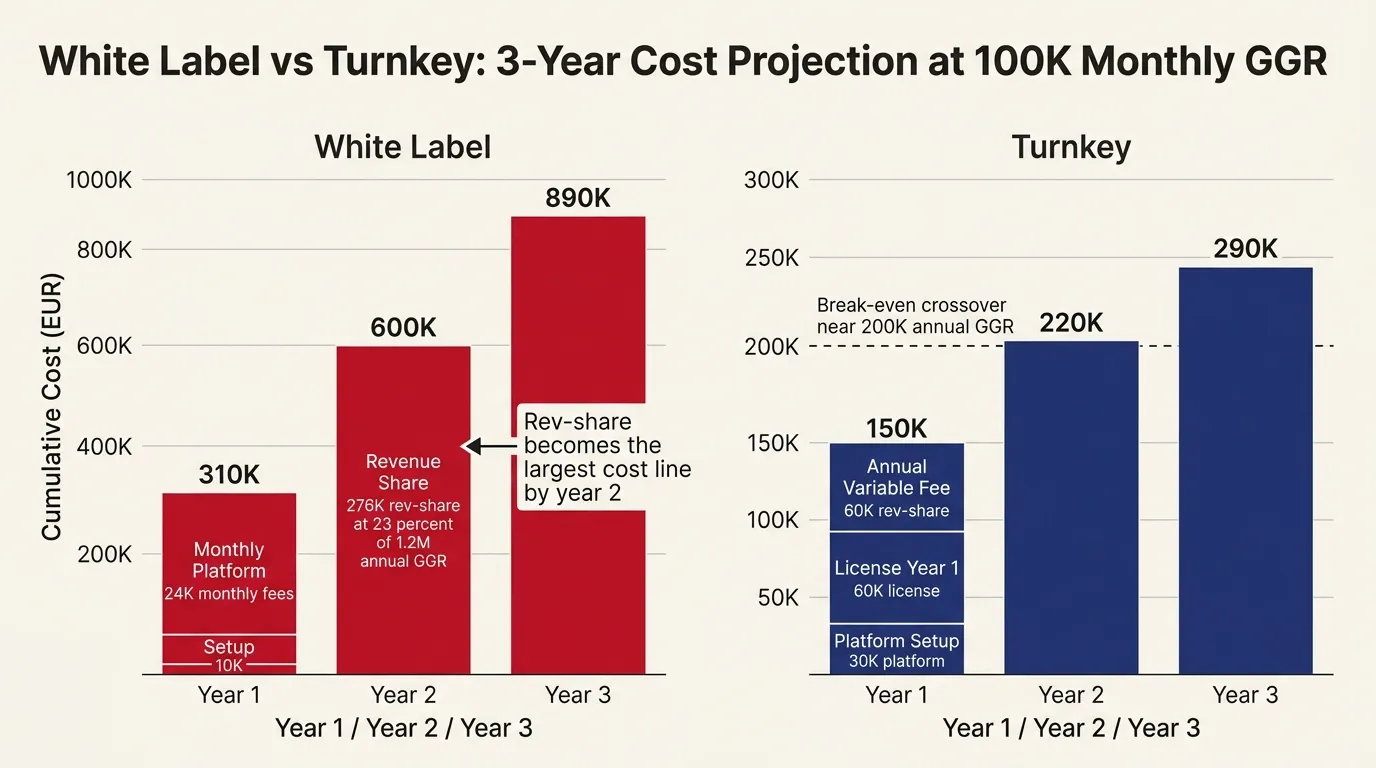
Total cost of ownership, not headline setup fees, is where operators consistently miscalculate. The Revenue Share Model in white label looks small as a percentage and quietly compounds into the largest cost line by year two. Turnkey carries the visible bill upfront and trails into a much lighter ongoing structure.
White label casino costs: setup fees, revenue share, and overlooked charges
Industry-standard white label economics break into five lines: setup ($10K-$30K), monthly platform fees ($2K-$10K), revenue share at 15-40% of GGR, rolling reserve of 5-10%, and payment processing surcharges. The revenue share is where operators underestimate cost. At 25% of GGR, a brand generating €100K monthly GGR sends €25,000 to the Online Casino Platform Provider every month before paying acquisition, content, or staff.
Rolling reserve is the second sleeper. The provider holds 5-10% of revenue in a security buffer against chargebacks and fines, typically released after 90-180 days. Operators see top-line revenue on the dashboard, but cash sits with the provider. Combined with rev-share, it is possible to be profitable on paper and short on payroll cash in the same month.
Turnkey casino costs: infrastructure investment and the price of independence
Turnkey economics cluster around higher upfront (platform licensing $50K-$200K+, independent license fees, integration, staffing) offset by a much lower or fixed ongoing fee. Treat the gap as the price of an owned asset, not a deterrent.
License costs vary sharply by jurisdiction. The MGA charges €5,000 to apply plus €25,000 annual Type 1 license fee, with compliance contributions scaling on GGR up to €375,000 per year for Type 1. Curaçao under the new LOK regime runs roughly €4,592 application plus $20K-$40K annual local substance, with first-year all-in around €60K. UKGC sits at the prestige end with longer timelines and material compliance overhead. A typical turnkey structure runs ~€30,000 setup with a 5% or lower variable fee, against white label’s €10K setup and 15%+ rev-share.
Long-term profitability: which model retains more revenue over time?
The break-even crossover lands near €200,000 in annual GGR. Compare a turnkey at €30K setup plus 5% of GGR against a white label at €10K setup plus 15% of GGR. The €20K setup gap closes when the rev-share difference (10 percentage points) on annual GGR equals that gap, which happens at €200K annual GGR. Below that, white label wins on cash. Above it, turnkey retains substantially more profit each year, and the spread widens with scale. The Revenue Share Model is the mechanism doing the work. Profitability is a trajectory question, not a binary one. The right answer depends on where the operator sits on the growth curve and how fast they expect to climb.
Licensing, compliance, and legal considerations
Licensing is the single most consequential structural difference between the two models. It determines jurisdiction access, legal protection, operational independence, and the long-term asset value of the business. Everything else negotiable; this one is not.
How white label solutions handle licensing: the sub-license model and its risks
Under a white label, the operator’s entire business depends on the Online Casino Platform Provider’s master gambling license staying active and compliant. If that master license is suspended, revoked, or surrendered, every sub-licensee on it freezes with it. There is no individual remediation path. The operator is exposed to a regulatory event they did not cause and cannot fix.
Tier-1 regulators have been tightening this for years. The MGA limits or prohibits white-label partnerships on its B2C licenses. Curaçao’s 2026 LOK reform went further. The master/sub-license model is gone, replaced by direct regulator-issued licenses to each operator. That eliminated what was effectively the last permissive jurisdiction for the sub-license route. The model is not dead, but it is on a managed runoff. Anyone signing a multi-year white label contract today should price that in.
Turnkey and independent licensing: what the application process involves
Independent licensing is slower and more expensive than a sub-license, and what you get on the other side is a business asset. UKGC and MGA are prestigious, demanding, and expensive. MGA application runs ~16 weeks in a clean case, often six months or more in complex ones. Curaçao under LOK is faster but no longer cheap. Isle of Man and Gibraltar occupy the mid-tier on cost and credibility.
The understated point in most competitor coverage: a company holding its own Gambling License is a fundamentally different and more valuable entity than one operating on a sub-license. It can be sold, recapitalized, audited, and inherited. A sub-licensee cannot transfer the license; the asset is the contract, not the entity.
| Jurisdiction | License Type | Typical Timeline | Approximate Cost (Y1) | Reputation / Market Access | Best For |
|---|---|---|---|---|---|
| MGA (Malta) | B2C Type 1-4 | 4-6+ months | €30K-€60K+ application/annual; GGR-banded compliance | EU passporting, premium trust signal | Regulated EU operators, brands targeting EEA |
| Curaçao (LOK) | B2C direct | 2-4 months | ~€60K Y1 incl. local substance | Broad acceptance, crypto-tolerant | Crypto-first, multi-vertical launches |
| Isle of Man | OGRA full | 4-6 months | ~£35K + ongoing | Strong trust, B2B-friendly | Operators wanting mid-tier credibility |
| UKGC | Remote Casino | 4-6+ months | £49K+ application alone, scaling on GGR | Highest player trust, hardest entry | UK-focused operators with compliance bench |
| Gibraltar | Class 1 / 2 | 3-6 months | £100K+ minimum guarantee + fees | Trusted, EU-friendly post-Brexit | Mid-large operators wanting LCB cover |
Pros and cons: an honest assessment of both models
A scannable consolidation of the trade-offs covered in depth above. The lists below are the operator-facing decision criteria, stripped of vendor-speak.
Pros of white label casino solutions
- Fast Time to Market. Typical launch in 4-8 weeks, skipping platform development entirely.
- Lower Initial Investment. No in-house dev team, no independent license fees in Year 1.
- Reduced technical complexity. The Online Casino Platform Provider runs maintenance, updates, and uptime.
- Pre-integrated content and payment relationships. Proven aggregator catalog, working PSP stack from day one.
- Ongoing technical support. Provider-side ops bench covers incidents and routine work.
Cons of white label casino solutions
- Customization is structurally limited. Branding and some front-end, no deep product changes.
- Revenue Share Model erodes margin at scale. 15-40% of GGR ongoing, every month, forever.
- Operator Control is low. No leverage to swap aggregators, change PSP routing, or migrate stacks.
- Player Data sits with the provider. Export rights are restricted in most contracts; CRM portability is limited.
- Sub-license sustainability risk. Tier-1 jurisdictions are restricting or eliminating the model.
Pros of turnkey casino solutions
- Full Operator Control over design, games, payments, and CRM. Every layer is yours to change.
- Higher revenue retention. Fixed or low variable fee instead of compounding GGR share.
- Full Customization. Real product differentiation, not template skinning.
- Scalability across markets without provider approval. Your license, your decisions.
- Player Data is owned outright. Portable, monetizable, and material to any exit valuation.
Cons of turnkey casino solutions
- Higher Initial Investment. Platform licensing $50K-$200K+ plus an independent Gambling License.
- Slower Time to Market. 3-6+ months including licensing, customization, and integration.
- Full operational responsibility. Compliance, customer support, fraud, payments, marketing all on the operator.
- Technical bench required. In-house or specialist partners for integration and incident response.
- Integration friction. Game studios, PSPs, and KYC vendors all require operator-side resolution.
Who should choose white label? Identifying the right operator profile
White label is the genuinely correct answer for first-time iGaming entrants with limited capital, no in-house compliance or tech bench, and a need to validate a market before committing to an independent license. It is also the right call for experienced operators testing a new geography before applying for a separate jurisdiction license. The diagnostic below assumes you have read the cost section honestly. Time to Market and Initial Investment are the two qualifiers that matter.
White label is right for you if:
- You are a first-time iGaming Industry entrant
- Your launch capital is under $100K
- You need a working brand in market in 4-8 weeks
- You have no in-house compliance or platform engineering team
- You are testing a target market before committing to a full license
- You are an affiliate launching your own operator brand
Who should choose turnkey? Identifying the right operator profile
Turnkey is the correct model for operators with prior iGaming experience or a serious operational team, $150K+ in deployable capital, a 3-5 year horizon, and ambitions that include real brand differentiation or a clean exit. Owned Player Data is what makes both CRM scale and exit valuation possible. The Gambling License you hold is what makes that ownership real. Operators that launch successfully on white label should plan a transition to a turnkey or owned-license stack within 2-3 years and use the early profits to fund it.
Turnkey is right for you if:
- You bring prior iGaming experience or a competent in-house team
- Your deployable capital is $150K+
- You are targeting a regulated Tier-1 market (UK, MGA, Ontario, Brazil)
- You want a differentiated brand, not template skinning
- You plan an eventual exit, recapitalization, or strategic sale
- You require Operator Control over the customer journey and Customization end-to-end
White label vs turnkey casino: the complete side-by-side comparison
The table below consolidates every decision criterion covered above. Each row maps to a section earlier in the article.
| Criterion | White Label | Turnkey |
|---|---|---|
| Launch Timeline | 4-8 weeks | 3-6+ months |
| Startup Cost | $10K-$30K setup + monthly fees | $50K-$200K+ platform + license |
| Revenue Model | 15-40% GGR ongoing | Fixed or 5% or less ongoing |
| License Type | Sub-license under provider | Independent (operator holds) |
| Platform Control | Low | High |
| Branding Depth | Skin and some front-end | End-to-end product brand |
| Tech Flexibility | Restricted to provider stack | Full, swap any layer |
| Customization Level | Limited | Full |
| Scalability | Provider-approved | Operator-decided |
| Data Ownership | Provider-controlled | Operator-owned |
| Regulatory Risk | Tied to provider’s master license | Tied to operator’s own license |
| Best For | New entrants, market tests, sub-$100K capital | Experienced operators, $150K+, exit horizon |
| Risk Level | Lower upfront, higher structural | Higher upfront, lower structural |
Top providers in the white-label and turnkey segment include PWP (PlayWinPlay) (★ Editor’s Choice for fastest launch with bundled active license and 15,000+ game catalog), SoftSwiss, EveryMatrix, Digitain, SoftGamings, and BetConstruct. Each is covered in our independent ranking with category-level scores.
Final verdict: how to choose between these two models
Choose white label only as a deliberately temporary entry, with the exit conditions written down before signing. It is the right answer for operators who genuinely need to learn the iGaming Industry while limiting capital exposure, and the wrong answer for everyone selling it as a long-term home. For operators with serious ambition, plan the transition to a turnkey or owned-license stack inside 2-3 years and use early profits to fund it.
The Revenue Share Model and the Gambling License are the two mechanisms that decide where you land. Define transition triggers in plain numbers before signing the white label contract: a GGR milestone (e.g., €100K monthly sustained for two quarters), a market validation metric (CAC payback under X months), and a parallel licensing timeline. Without those triggers, the model becomes the destination by default, and the Operator Control problem becomes permanent. Strategic operators decide their exit on entry, not later.
Frequently asked questions
Can I switch from a white label casino to a turnkey solution later?
Yes, but plan it before signing. The real obstacles are Player Data portability clauses in the original contract, capital for an independent Gambling License, and the 4-6 month parallel licensing timeline. Establish written transition triggers (GGR milestones, market validation metrics, and license application start date) inside the white label contract itself.
Who owns the player data in a white label vs turnkey casino?
In a turnkey solution the operator owns the player database outright. In white label, agreements frequently restrict or limit data export rights, leaving the database effectively under provider control. This is a critical clause to negotiate before signing. Without portable Player Data, CRM monetization and any future exit valuation are materially constrained.
What are the hidden costs of white label casino solutions?
Three categories quietly compound. Rolling reserves of 5-10% of revenue, withheld 90-180 days, that tie up cash on profitable months. Payment processing surcharges layered above the provider’s PSP rates. And the cumulative margin erosion of a 15-40% Revenue Share Model: at €100K monthly GGR and 25% share, that is €300,000 paid to the provider annually.
Related
This site may earn referral commissions from provider links, disclosed transparently per FTC guidelines. No providers paid for placement or ranking. Editorial scoring uses one consistent eight-category framework across all 16 providers; see Methodology.